
Which North Carolina Records Are Open
Chapter 132 broadly covers material made or received while a North Carolina agency conducts public business. Access still depends on the statute governing the specific record and on who keeps it. A county register records land instruments. A Clerk of Superior Court keeps case, estate, and divorce files. Tax offices maintain parcel rolls, while state agencies publish court, corporation, license, and correctional data.
| Record group | Legal keeper | Web starting point | Access route |
|---|---|---|---|
| Deeds, liens, plats | County Register of Deeds | County-specific index | Free index where offered; office image or certified copy |
| Trial cases and estates | Filing-county Clerk of Superior Court | Statewide eCourts Portal | Portal, clerk terminal, file inspection, or copy order |
| Parcel and tax roll | County tax administration | County property search | Free current roll; counter or request for older cards |
| Birth, death, marriage | County Register and NC Vital Records | County index or state order portal | Eligibility, identification, and product rules apply |
| Custody and registration | NC DAC, SBI, or county sheriff | Agency-specific search | Free published fields; agency request for other open material |
| Business and licenses | Secretary of State or licensing board | Official agency search | Free status search; copy or certification may cost |
“Open” does not mean that every field appears online. Sealed matters, adoption and juvenile material, protected identifiers, some vital products, criminal intelligence, and DMV personal information remain restricted. An agency must separate or redact protected material when the rest can be released. For the statute itself, read the North Carolina Public Records Law.
The official Chapter 132 text is also visible in the General Assembly source captured here.
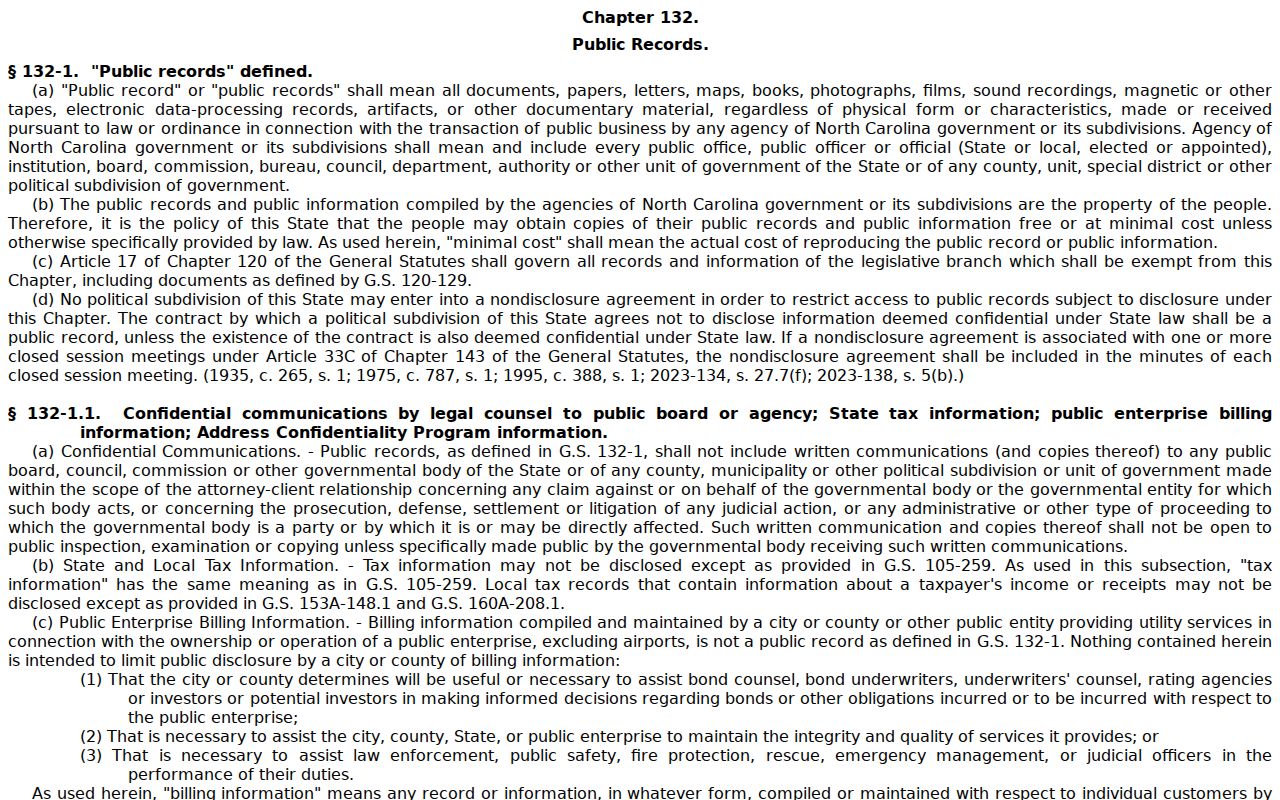
The chapter is the general access rule, while other statutes decide whether a particular field or certificate may be released.
North Carolina Records Span Counties
North Carolina has 100 counties and no single public records custodian. Each county has its own elected Register of Deeds, Clerk of Superior Court, tax administration office, and local records channels. Statewide discovery may identify a county, but verification often shifts to that county’s legal keeper. The Register of Deeds finder and the Judicial Branch county location directory route requests to the correct office.
County geography also changes over time. An early deed, marriage bond, estate, or court minute may belong to a parent county if the current county had not yet been formed. The State Archives county guides identify surviving originals, microfilm, and transferred series. Current statewide court access does not erase these county-level differences.
County first. Use the county where the property, case, event, or booking occurred, not merely the postal city shown in an address.
North Carolina Deed Index Access
Recorded land documents remain county records. Wake County’s Consolidated Real Property Index offers a useful, clearly documented example, but its interface and coverage cannot be assigned to every county. A grantor is the party transferring an interest; a grantee receives it. Searches can also use a known book and page, instrument number, date span, or document type.
| CRPI control | Input kind | When needed | How it narrows a search |
|---|---|---|---|
| Last or firm name | Text | Normally required for name route | Finds an indexed surname or business |
| First and middle name | Text | Optional | Separates similar party names |
| Grantor or grantee | Selector | Optional | Limits the indexed party role |
| Book and page | Number pair | Conditional | Retrieves a known citation |
| Instrument number | Text or number | Conditional | Opens a known filing |
| Recorded from and to | Date pair | Optional | Reduces broad name results |
A result may expose parties, recording date, book and page, parcel identifiers, legal description, and an image. The image is an informational research copy. Certification comes from the county register. No authoritative source establishes one universal Wake online start year for every series, so missing results should move to older index books, the office terminal, mail, or staff help.
North Carolina eCourts Record Search
The eCourts Portal now searches cases across all 100 counties. Smart Search accepts a case number or party and business name. A partial surname needs at least three characters before a wildcard, while a partial first name needs at least one. Hearing searches can use party, attorney, bar number, judicial officer, courtroom, or case number. Judgment filters include party, case, type, status, place, and date.
Portal timelines can display case summary, parties, causes, events, dispositions, hearings, and available financial data. A docket is the chronological list of case activity, not the whole official file. Sealed items, protected juvenile or adoption information, confidential identifiers, and some attachments will not appear. Older paper pleadings may remain at the filing-county clerk even after statewide conversion.
The Judicial Branch explains those fallback channels in its court record access guidance.
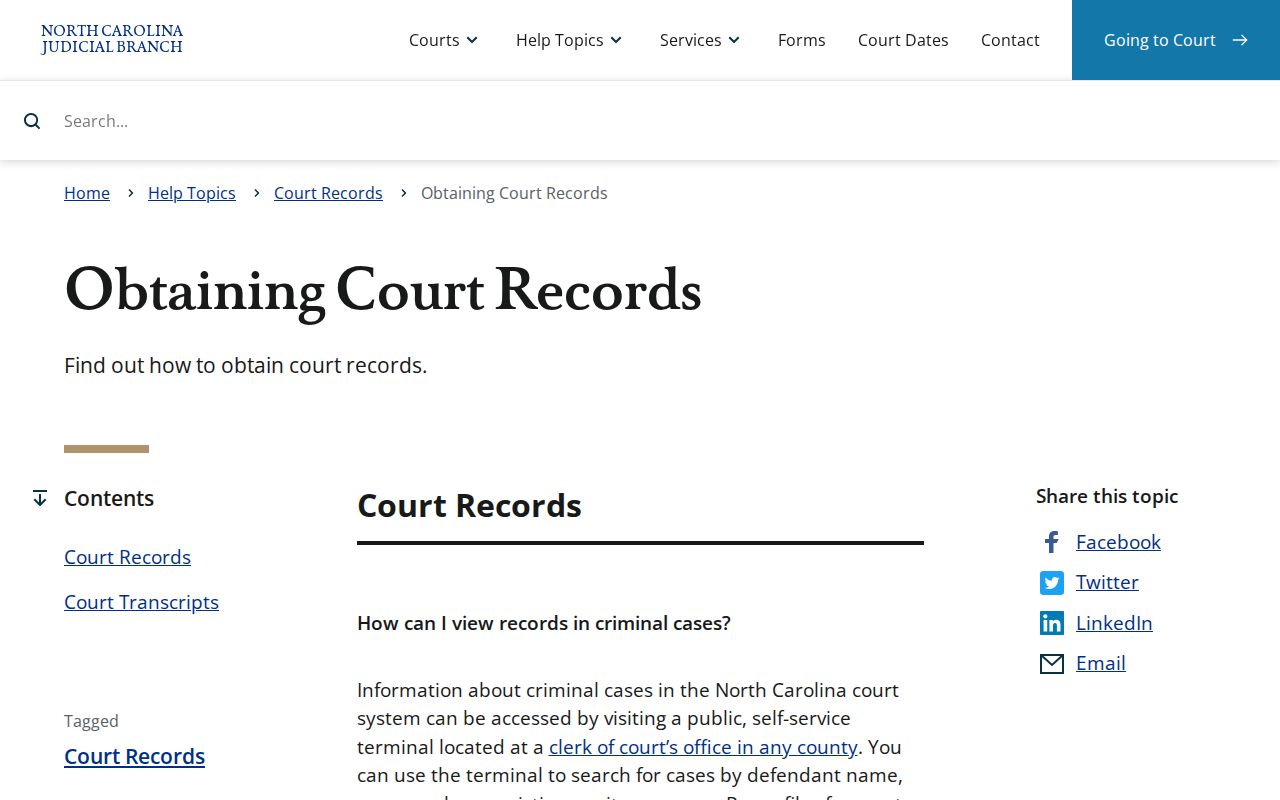
The filing-county clerk can provide the file, make copies, and certify court documents when a portal summary is not enough.
North Carolina Property Records by County
County tax rolls connect an owner name with a parcel, its situs address, mailing address, assessed value, and often a deed citation. “Situs” means the physical property location. The owner’s mailing address may be different and can point outside the county or state. It is useful contact evidence, but it does not prove that the owner lives at the property.
North Carolina has no single authoritative statewide owner-name portal. Wake’s Real Estate Search accepts owner, property address, REID, or PIN. NC OneMap aggregates parcel geometry statewide, while county tax and GIS systems remain authoritative. A GIS boundary is informational, not a legal survey. For older ownership, take the deed book and page from the parcel card back to the county land index.
Note: Current tax data, parcel maps, and recorded deeds answer different questions, so confirm ownership through the county’s official roll and instrument.
North Carolina Vital Record Limits
North Carolina does not use one blanket rule under which every vital certificate becomes unrestricted after a fixed number of years. G.S. 130A-93 and the current application rules control the product, requester eligibility, identification, and purpose. County registers issue locally filed birth, death, and marriage records. NC Vital Records issues statewide birth, death, marriage, and divorce certificates.
A certified copy is an official copy attested by the legal custodian. The state statutory search and first-copy fee is $24, with $15 for each extra copy of the same record ordered at the same time. County schedules and online or expedited service charges can differ. A divorce certificate reports the event, but the granting-county Clerk of Superior Court holds the divorce judgment.
Order paths and application choices appear on the NC Vital Records certificate page.
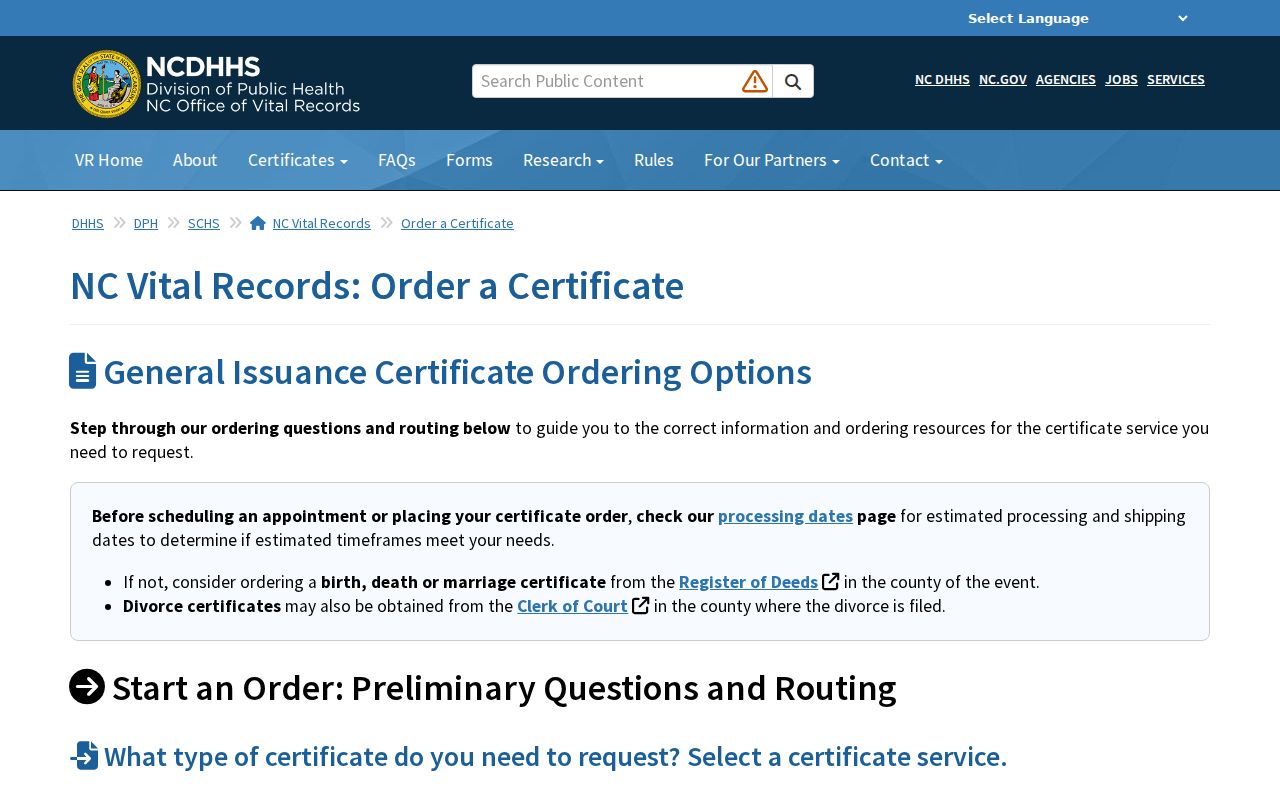
The source distinguishes state and county ordering channels, which may have different processing methods and total charges.
North Carolina Custody Record Channels
Custody data is divided by jurisdiction. The NC Offender Public Information Search covers people in state prison or Community Corrections data, not every county booking. County sheriffs control jail rosters. The SBI maintains the sex offender registry, and the federal Bureau of Prisons has a separate locator.
A state correctional result may show a name or alias, offender number, demographic descriptors, conviction and sentence data, custody location, and release or supervision dates. Those operational dates can change. For a county without an online jail roster, contact its detention center, seek the open booking portion under Chapter 132, or inspect the related clerk file. Criminal intelligence, protected victim details, and juvenile records may be withheld.
Registry information is published for public protection. It must never be used to threaten, harass, or intimidate a person, and suspected errors should be reported to the responsible sheriff.
North Carolina Public Records Offices
The right office depends on the legal record. State agencies handle statewide certificates, corrections data, and administrative Judicial Branch material. County offices retain land instruments, parcel rolls, local certificates, and official trial-court files. These starting points keep a request with the actual custodian instead of a general state inbox.
State Archives
Transferred county originals, microfilm, and finding aids
The Judicial Branch provides a separate form for administrative material. Its records request source is shown here.
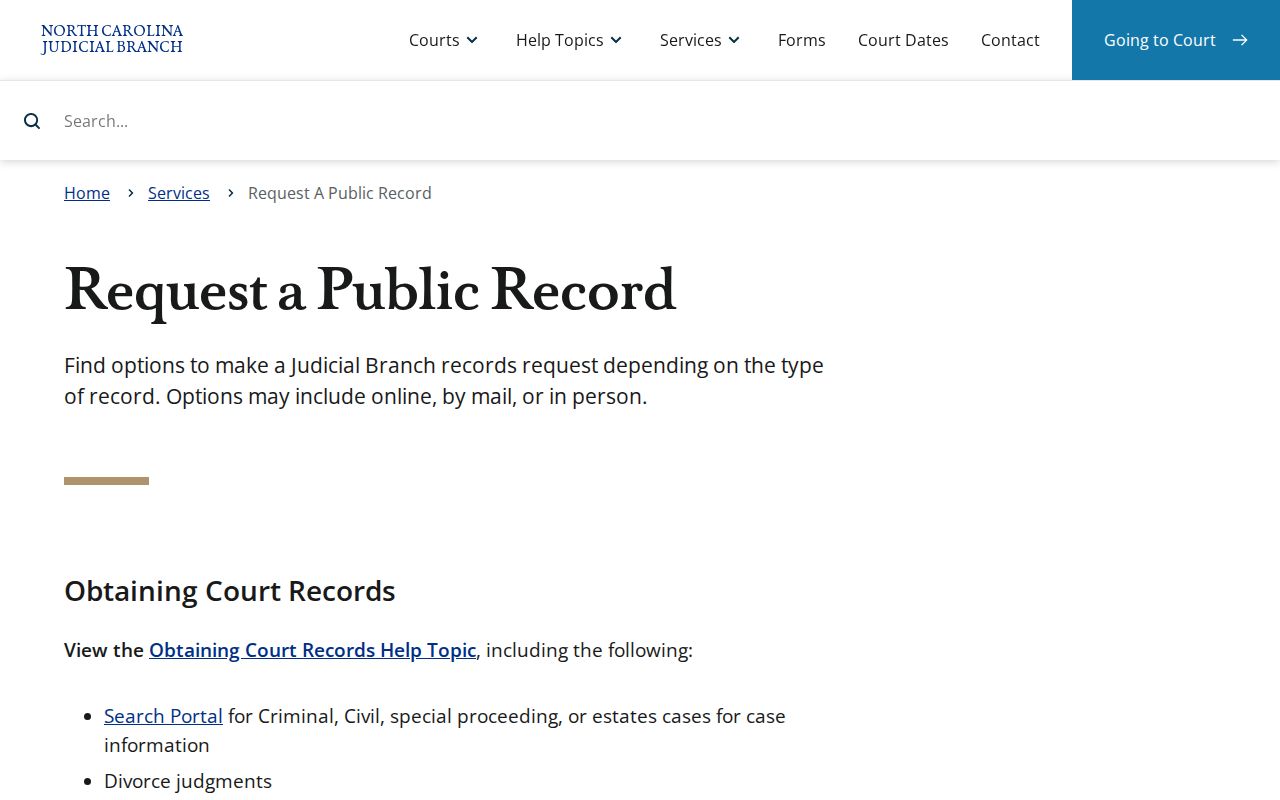
That form is not the route for a local case file, deed, or city record. Send those to the clerk, register, or local agency that holds them.
North Carolina Record Access Terms
Portal results and official copies serve different needs. These terms help separate a quick search result from proof issued by the keeper.
- Custodian
- The office legally responsible for keeping and releasing a record.
- Index
- A searchable list of names, dates, numbers, and document types used to locate a filing.
- Image
- A scan of the filed document, which may still be an unofficial research copy.
- Certified copy
- A copy authenticated by the legal keeper for an official use.
- Exemption
- A law that closes a record or field that would otherwise fall within the general access rule.
Inspection of public records is generally free under Chapter 132. Ordinary copies may be charged at actual cost, while a reasonable special service charge can apply to extensive technology, clerical, or supervisory work. Statutory charges govern certified court, register, and vital copies.
North Carolina Records Gain Redaction Tools
A 2025 amendment to G.S. 132-1.10 expressly permits registers of deeds, clerks, and the Administrative Office of the Courts to use optical character recognition or other reasonably available technology to identify and redact protected financial and identity information. The same law directs release of the nonconfidential remainder.
People may request free removal of a protected number or password from an online deed or court image. A valid request identifies the information, document, and exact location and may be submitted by mail, fax, electronic transmission, or in person. An unauthorized request can bring a fine of up to $500 per violation. The process protects specified data without erasing the whole public filing.
Statewide and County Access Compared
North Carolina’s digital court system and its county land systems now follow different access patterns. The contrast matters when a search stops at a portal screen.
| Access layer | What it does well | What still needs an office |
|---|---|---|
| Statewide eCourts | Finds current electronic case summaries across all counties | Older paper pleadings, restricted attachments, certification |
| County deed index | Finds local instruments by party or citation | Series not online, older books, certified instruments |
| County tax and GIS | Connects current owner, parcel, address, and map | Archived cards and legal boundary proof |
| State Archives | Identifies transferred series and surviving dates | Search-room review or copy request when no image exists |
Statewide eCourts completion in October 2025 did not digitize every historical page. Portal discovery should lead to the filing-county clerk when the official file is needed, just as a county index citation should lead to the register for certification.
Request North Carolina Public Records
North Carolina's public-records request gateway routes readers toward the state agency that holds a record. G.S. 132-6 allows any person to inspect and obtain copies “as promptly as possible.” It sets no fixed number of business days. An agency need not create a report, answer research questions, compile new data, or convert a record into a format it cannot produce. A narrow request for an identifiable existing record is easier to route, price, review, and fulfill.
- Name the custodian. Choose the register for an instrument, assessor for a parcel card, clerk for a case file, sheriff for a booking record, or issuing agency for its own administrative material.
- Search first. Save a stable identifier such as book and page, PIN, case number, report number, license number, office, or date span.
- Describe the existing record. Give the record series, names, office or division, date range, identifiers, and desired electronic or inspection format.
- Use the posted channel. Submit through the agency portal, email, public-information officer, mail route, or counter. The Judicial Branch administrative form does not replace a filing-county clerk request.
- Control the cost. Ask for an estimate before chargeable copying or extensive service, and request free inspection when copies are not needed.
- Address a denial. Ask for the cited exemption and any segregable portion. Chapter 132 has no administrative appeal board; G.S. 132-9 permits Superior Court enforcement.
The NCAOC administrative form asks for requester contact details, a focused description, delivery preference, and an optional attachment. It may be filed online or mailed to Public Records Request, PO Box 2448, Raleigh, NC 27602. Published Judicial Branch administrative copies cost $0.25 per page, with notice required for an extraordinary charge.
Lawful personal use. Open access does not permit stalking, threats, harassment, or attempts to defeat a protected address. Verify facts with the custodian and respect every redaction.